7 Topics
 5 Days
 35 Sessions
Programme Overview
Training Description
Emergency Management Officials (Local/State/Federal)
Urban Planners and City Administrators
First Responders (Police, Fire, EMS)
Public Works and Infrastructure Managers
Disaster Risk Reduction (DRR) Specialists
NGO/Humanitarian Aid Workers in urban contexts
Public Health Officials and Healthcare Administrators
Private Sector Leaders and Business Continuity Managers
Session Objectives
- Critically analyze a range of historical events and conceptual perspectives of hazard, vulnerability, and risk. Evaluate the benefits and challenges of implementing effective risk mitigation. Critique approaches to managing residual risks via preparedness systems and emergency planning. Propose good practice approaches for emergency operations plan development. Assess the need for organizational resilience and good governance in effective disaster management. Evaluate and apply community-centered frameworks for resilience, sustainability, and development.
About the Course
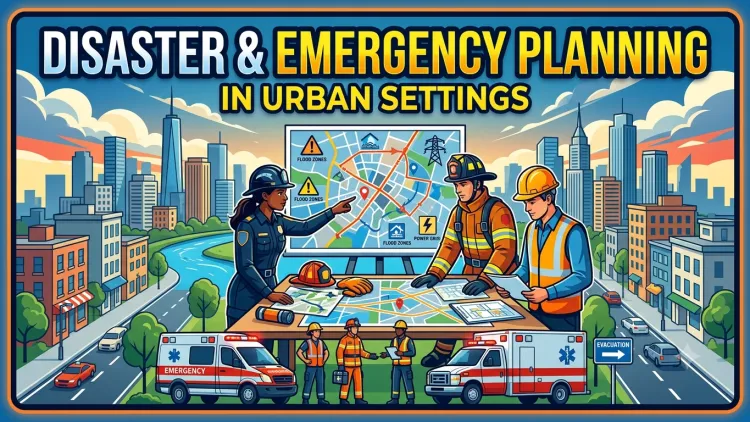
This training equips participants with a practical understanding of methodologies, tools, and best practices to develop integrated emergency planning programs in densely populated urban environments. With a focus on an all-hazards approach to emergency operations planning (EOP), the program ensures that preparedness is seamlessly integrated with mitigation and recovery activities.
Through critical analysis of urban-specific risks, participants will learn to design multi-disciplinary response strategies. The curriculum emphasizes public-private sector teamwork to enhance community resilience and drive sustainable development following a catastrophe.
Curriculum & Topics
7 Topics | 35 Sessions
-
 Workshop 1.1:
Key characteristics of urban disaster risk environments
Workshop 1.1:
Key characteristics of urban disaster risk environments
-
Workshop 1.2:
Drivers of vulnerability in cities and towns
-
Workshop 1.3:
Patterns of urban growth and exposure
-
Workshop 1.4:
Impacts of disasters on urban systems and services
-
Workshop 1.5:
Multi-hazard scenarios in urban contexts
-
Workshop 2.1:
Hazard identification and mapping in dense urban settings
-
Workshop 2.2:
Exposure analysis of people, buildings, and infrastructure
-
Workshop 2.3:
Risk profiling and prioritization
-
Workshop 2.4:
Use of GIS and remote sensing in urban risk planning
-
Workshop 2.5:
Case studies of urban disaster hotspots
-
Workshop 3.1:
Urban emergency planning cycle and frameworks
-
Workshop 3.2:
Community-based preparedness in urban neighborhoods
-
Workshop 3.3:
Designing evacuation, shelter, and logistics plans
-
Workshop 3.4:
Urban search and rescue integration
-
Workshop 3.5:
Ensuring continuity of critical city services
-
Workshop 4.1:
Urban infrastructure interdependencies and fragility
-
Workshop 4.2:
Risk mitigation for transport, energy, and water systems
-
Workshop 4.3:
Safe hospital and school initiatives in cities
-
Workshop 4.4:
Urban resilience hubs and decentralization strategies
-
Workshop 4.5:
Public-private partnerships in infrastructure protection
-
Workshop 5.1:
Climate-related risks in urban disaster planning
-
Workshop 5.2:
Nature-based solutions and green infrastructure
-
Workshop 5.3:
Integrating DRR into city master plans
-
Workshop 5.4:
Urban flood, heat, and storm resilience strategies
-
Workshop 5.5:
Long-term recovery and resilience programming
-
Workshop 6.1:
Local governance and legal frameworks for urban DRR
-
Workshop 6.2:
Inter-agency coordination and multi-stakeholder engagement
-
Workshop 6.3:
Mainstreaming risk into municipal budgeting and services
-
Workshop 6.4:
Role of national-local linkages in disaster governance
-
Workshop 6.5:
Building institutional capacity at the city level
-
Workshop 7.1:
Smart cities and digital platforms for emergency management
-
Workshop 7.2:
Mobile and ICT solutions for urban early warning
-
Workshop 7.3:
Data-driven decision support systems
-
Workshop 7.4:
Real-time coordination and crisis mapping tools
-
Workshop 7.5:
Innovations in inclusive and participatory planning