15 Topics
 5 Days
 60 Sessions
Programme Overview
Training Description
Aquaculture farmers and managers
Fisheries managers and officers
Marine and freshwater biologists
Environmental consultants
Policymakers and government officials
Seafood industry professionals
Conservationists and NGOs
Researchers and scientists
Agricultural extension officers and advisors
Rural development practitioners
Students of marine science and environmental management
Individuals interested in sustainable seafood production
Session Objectives
- Understand the principles and benefits of sustainable aquaculture and fisheries management. Implement techniques for assessing fish stock health and population dynamics. Understand the role of ecosystem-based management in fisheries. Implement techniques for developing and implementing sustainable fisheries management plans. Understand the principles of responsible aquaculture practices. Implement techniques for selecting and managing sustainable aquaculture systems. Understand the role of water quality and environmental management in aquaculture. Implement techniques for minimizing environmental impacts in aquaculture operations
About the Course
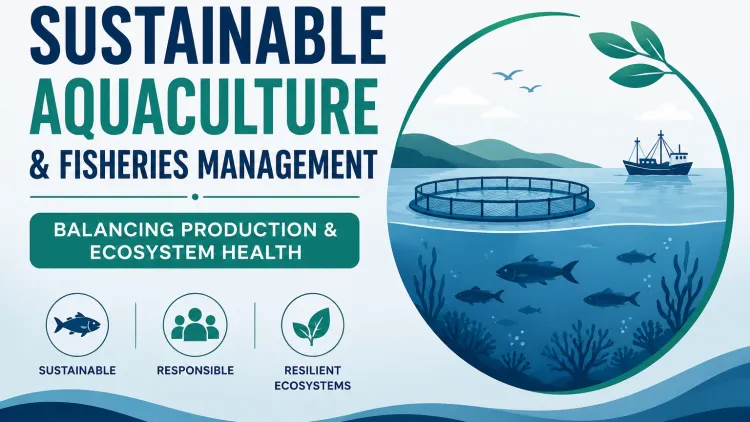
Sustainable Aquaculture and Fisheries Management equips professionals with the knowledge and skills to ensure the long-term health and productivity of aquatic resources. This course focuses on implementing responsible aquaculture practices, optimizing fisheries management strategies, and understanding the ecological impacts of aquatic resource exploitation. Participants will learn to balance economic needs with environmental sustainability, promote biodiversity, and secure food resources for future generations. By mastering sustainable aquaculture and fisheries management, professionals can contribute to the resilience of aquatic ecosystems and the livelihoods of communities dependent on them.
The growing demand for seafood necessitates a shift towards sustainable practices that mitigate environmental degradation and ensure resource availability. This course delves into the complexities of aquatic ecosystems, explores innovative aquaculture technologies, and examines effective fisheries governance models. By integrating ecological principles with practical management techniques, this program empowers participants to make informed decisions that promote responsible resource utilization and conservation.
Curriculum & Topics
15 Topics | 60 Sessions
-
 Workshop 1.1:
Principles and benefits of responsible aquatic management.
-
Workshop 1.2:
Understanding the role of ecosystems in fisheries and aquaculture.
-
Workshop 1.3:
Benefits of balancing production with conservation.
-
Workshop 1.4:
Historical context and modern sustainable practices.
-
Workshop 2.1:
Techniques for assessing fish stock abundance and distribution.
-
Workshop 2.2:
Implementing population modeling and stock assessments.
-
Workshop 2.3:
Utilizing data collection and analysis methods.
-
Workshop 2.4:
Managing fisheries data and information systems.
-
Workshop 3.1:
Understanding the role of ecological interactions in fisheries.
-
Workshop 3.2:
Implementing ecosystem modeling and analysis.
-
Workshop 3.3:
Utilizing habitat assessments and mapping.
-
Workshop 3.4:
Managing integrated fisheries management plans.
-
Workshop 4.1:
Techniques for developing and implementing management strategies.
-
Workshop 4.2:
Implementing catch quotas and size limits.
-
Workshop 4.3:
Utilizing gear restrictions and closed seasons.
-
Workshop 4.4:
Managing fisheries monitoring and enforcement.
-
Workshop 5.1:
Understanding the role of aquaculture in food security.
-
Workshop 5.2:
Implementing best practices in aquaculture production.
-
Workshop 5.3:
Utilizing integrated multi-trophic aquaculture (IMTA).
-
Workshop 5.4:
Managing aquaculture site selection and planning.
-
Workshop 6.1:
Techniques for selecting and managing appropriate aquaculture systems.
-
Workshop 6.2:
Implementing recirculating aquaculture systems (RAS).
-
Workshop 6.3:
Utilizing pond culture and cage aquaculture.
-
Workshop 6.4:
Managing species selection and stocking densities.
-
Workshop 7.1:
Understanding the impact of aquaculture on water quality.
-
Workshop 7.2:
Implementing water quality monitoring and treatment.
-
Workshop 7.3:
Utilizing effluent management and waste reduction.
-
Workshop 7.4:
Managing environmental impacts in aquaculture operations.
-
Workshop 8.1:
Techniques for reducing nutrient and chemical inputs.
-
Workshop 8.2:
Implementing sustainable feed management.
-
Workshop 8.3:
Utilizing biofiltration and bioremediation.
-
Workshop 8.4:
Managing farm site restoration and rehabilitation.
-
Workshop 9.1:
Techniques for implementing seafood traceability systems.
-
Workshop 9.2:
Utilizing eco-labeling and certification programs.
-
Workshop 9.3:
Implementing supply chain management.
-
Workshop 9.4:
Managing consumer awareness and market access.
-
Workshop 10.1:
Techniques for minimizing bycatch in fisheries.
-
Workshop 10.2:
Implementing selective fishing gear and practices.
-
Workshop 10.3:
Utilizing bycatch reduction devices.
-
Workshop 10.4:
Managing waste utilization and processing.
-
Workshop 11.1:
Understanding national and international fisheries and aquaculture laws.
-
Workshop 11.2:
Implementing licensing and permitting procedures.
-
Workshop 11.3:
Utilizing environmental impact assessments.
-
Workshop 11.4:
Managing legal compliance and enforcement.
-
Workshop 12.1:
Analyzing the economic benefits of sustainable practices.
-
Workshop 12.2:
Evaluating the costs and returns of aquaculture and fisheries.
-
Workshop 12.3:
Identifying market opportunities for sustainable seafood.
-
Workshop 12.4:
Managing financial planning and investment.
-
Workshop 13.1:
Developing communication and outreach strategies.
-
Workshop 13.2:
Building stakeholder partnerships and collaborations.
-
Workshop 13.3:
Implementing training programs for sustainable practices.
-
Workshop 13.4:
Scaling up successful management models.
-
Workshop 14.1:
Analyzing real-world examples of sustainable aquaculture and fisheries.
-
Workshop 14.2:
Highlighting best practices and innovative techniques.
-
Workshop 14.3:
Documenting economic and environmental impacts.
-
Workshop 14.4:
Industry and community testimonials.
-
Workshop 15.1:
Exploring emerging trends and innovations.
-
Workshop 15.2:
Integrating new technologies and research findings.
-
Workshop 15.3:
Adapting to evolving climate scenarios and market demands.
-
Workshop 15.4:
Building resilient and sustainable aquatic ecosystems.