7 Topics
 5 Days
 35 Sessions
Programme Overview
Training Description
- NGO Programme and Finance Managers
- Development Finance Professionals
- Grant and Donor Finance Managers
- Budget Analysts
- Financial Controllers
- Strategic Planning Managers
- Programme and Project Managers
- Economists and Financial Analysts
- Monitoring and Evaluation Professionals
- Development Planning Specialists
- Professionals responsible for multi-year budgeting, strategic financial planning, resource allocation, funding management, and organizational sustainability
Session Objectives
- Understand the principles and benefits of multi-year budgeting. Develop a framework for long-range financial forecasting. Align multi-year budgets with strategic goals and mission. Implement effective revenue and expenditure forecasting techniques. Manage uncertainty and risk in long-term financial planning.
About the Course
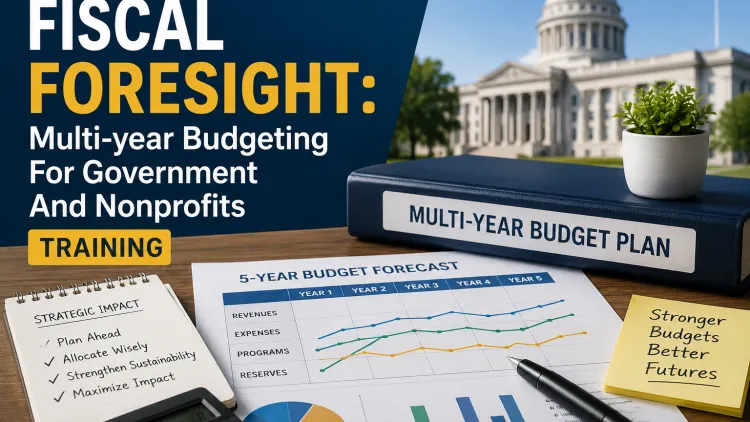
Fiscal Foresight: Multi-Year Budgeting for Government and Nonprofits is a practical training course designed to equip public-sector and nonprofit professionals with the skills required to develop credible, sustainable, and forward-looking multi-year financial plans.The course moves beyond short-term annual budgeting to explore how organizations can align financial resources with long-term strategic priorities, programme commitments, development objectives, and changing economic conditions. Participants will learn how to construct multi-year revenue and expenditure projections, develop realistic financial assumptions, manage funding uncertainty, prioritize programmes, plan capital investments, and strengthen long-term financial sustainability.
Particular emphasis is placed on the challenges faced by government agencies and nonprofits, including limited fiscal space, donor funding uncertainty, inflation, changing policy priorities, restricted funding, economic shocks, and long-term programme commitments.
Curriculum & Topics
7 Topics | 35 Sessions
-
 Workshop 1.1:
The difference between annual and multi-year budgeting.
-
Workshop 1.2:
The benefits of a multi-year financial framework.
-
Workshop 1.3:
Key components of a multi-year financial plan.
-
Workshop 1.4:
Aligning mission, strategy, and the budget.
-
Workshop 1.5:
The role of leadership in the multi-year process.
-
Workshop 2.1:
Forecasting methods for government tax revenues and grants.
-
Workshop 2.2:
Projecting individual giving and foundation support for nonprofits.
-
Workshop 2.3:
Analyzing historical data and economic indicators.
-
Workshop 2.4:
Identifying and quantifying potential funding risks.
-
Workshop 2.5:
Building a diversified funding model for long-term sustainability.
-
Workshop 3.1:
Projecting personnel costs, including benefits and salary increases.
-
Workshop 3.2:
Forecasting operational expenses and capital needs.
-
Workshop 3.3:
The impact of inflation and market changes on expenses.
-
Workshop 3.4:
Using programmatic data to forecast program-specific costs.
-
Workshop 3.5:
Zero-based budgeting and activity-based costing for efficiency.
-
Workshop 4.1:
Integrating capital expenditures into the multi-year budget.
-
Workshop 4.2:
Evaluating the long-term cost of new facilities or technology.
-
Workshop 4.3:
Financing options for major projects.
-
Workshop 4.4:
Prioritizing capital projects based on strategic impact.
-
Workshop 4.5:
The role of depreciation and asset management.
-
Workshop 5.1:
Identifying financial risks and developing mitigation strategies.
-
Workshop 5.2:
Using scenario planning to test budget resilience.
-
Workshop 5.3:
Creating contingency plans for potential funding cuts or shortfalls.
-
Workshop 5.4:
Analyzing the impact of policy changes on your budget.
-
Workshop 5.5:
Building a crisis-resistant financial model.
-
Workshop 6.1:
The process of developing and approving a multi-year budget.
-
Workshop 6.2:
Presenting the financial plan to boards and government bodies.
-
Workshop 6.3:
Communicating the budget to staff and the public.
-
Workshop 6.4:
Ensuring buy-in and accountability across departments.
-
Workshop 6.5:
Using financial reporting to track progress against the plan.
-
Workshop 7.1:
The importance of regular budget reviews and adjustments.
-
Workshop 7.2:
Integrating the multi-year budget into the annual budget cycle.
-
Workshop 7.3:
Leveraging technology for forecasting and reporting.
-
Workshop 7.4:
Learning from best-in-class examples of multi-year budgeting.
-
Workshop 7.5:
A final workshop: creating a multi-year budget for a case study organization.