
 9 Topics
 5 Days
Programme Overview
Training Description
Chief Financial Officers (CFOs) and financial directors
Enterprise risk managers
Financial analysts and controllers
Business continuity and resilience managers
Operational and supply chain directors
IT and cybersecurity managers
Strategic planning professionals
Heads of corporate treasury
Project managers
Investors and board members
Session Objectives
- Understand the core principles of proactive risk-based budgeting. Develop a systematic approach to identifying and quantifying financial risks. Master the creation and management of dedicated contingency funds. Implement robust scenario planning and stress-testing methodologies. Formulate clear financial protocols for crisis response and emergency spending. Align contingency plans with overall business continuity strategies.
About the Course
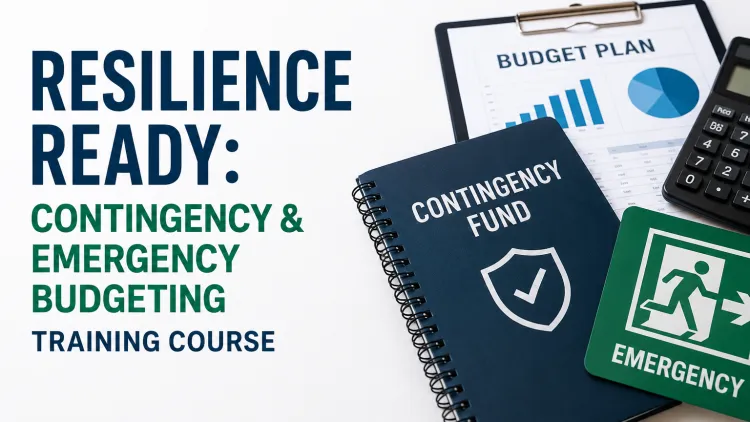
In an increasingly unpredictable business landscape, organizations face a myriad of threats, from supply chain disruptions and economic downturns to unforeseen emergencies and market volatility. Relying solely on static, annual budgets leaves businesses vulnerable to these shocks, threatening financial stability and long-term viability. This course is designed to equip financial leaders and strategic planners with the proactive tools and strategic foresight needed to build robust, resilient financial frameworks. We will explore how to transition from reactive measures to a predictive and prepared budgeting model that secures business continuity and protects against future crises.
This 5-day immersive program will provide a deep dive into the art and science of contingency and emergency budget planning. Participants will gain practical skills in identifying and quantifying risks, developing dynamic scenario-based financial models, and creating dedicated reserve funds that act as a financial safety net. By the end of this course, attendees will be fully prepared to develop and implement a comprehensive financial resilience strategy, ensuring their organizations can not only survive but thrive amidst unexpected challenges.
Curriculum & Topics
9 Topics | 5 Days
-
 Subtopic 1.1:
The importance of a risk-based approach to budgeting.
Subtopic 1.1:
The importance of a risk-based approach to budgeting.
-
Subtopic 1.2:
Differentiating between contingency, emergency, and reserve funds.
-
Subtopic 1.3:
Defining key concepts: risk appetite, financial exposure, and variance analysis.
-
Subtopic 1.4:
Integrating risk assessment into the annual budgeting cycle.
-
Subtopic 1.5:
Case studies of successful and failed contingency planning.
-
Subtopic 2.1:
Identifying potential financial risks across business functions.
-
Subtopic 2.2:
Methodologies for quantifying the financial impact of risks.
-
Subtopic 2.3:
Using qualitative and quantitative data to inform budget allocations.
-
Subtopic 2.4:
The role of historical data in forecasting future risks.
-
Subtopic 2.5:
Prioritizing risks based on likelihood and impact.
-
Subtopic 3.1:
Best practices for establishing and funding a contingency budget.
-
Subtopic 3.2:
Determining the appropriate size and structure of a reserve fund.
-
Subtopic 3.3:
Accounting for a contingency fund in financial statements.
-
Subtopic 3.4:
Rules and governance for accessing emergency funds.
-
Subtopic 3.5:
Managing and reporting on the utilization of contingency budgets.
-
Subtopic 4.1:
Developing "what-if" models for various risk scenarios.
-
Subtopic 4.2:
Using stress testing to evaluate budget robustness.
-
Subtopic 4.3:
Creating trigger points for activating different contingency plans.
-
Subtopic 4.4:
Budgeting for market downturns and economic shifts.
-
Subtopic 4.5:
Simulating the financial impact of a major operational failure.
-
Subtopic 5.1:
Establishing clear lines of authority for emergency spending.
-
Subtopic 5.2:
Protocols for rapidly reallocating budgets during a crisis.
-
Subtopic 5.3:
Prioritizing expenditures when faced with a budget shortfall.
-
Subtopic 5.4:
Techniques for cash flow management during a financial emergency.
-
Subtopic 5.5:
The role of the finance team in a crisis command center.
-
Subtopic 6.1:
Budgeting for supply chain disruptions and procurement risks.
-
Subtopic 6.2:
Allocating funds for alternative suppliers and logistics.
-
Subtopic 6.3:
Financial planning for operational shutdowns and recovery.
-
Subtopic 6.4:
The cost of inventory buffers and redundant systems.
-
Subtopic 6.5:
Managing foreign exchange and commodity price volatility.
-
Subtopic 7.1:
Allocating budget for unexpected IT infrastructure failures.
-
Subtopic 7.2:
The financial cost of data breaches and cyber attacks.
-
Subtopic 7.3:
Budgeting for disaster recovery and business continuity for IT.
-
Subtopic 7.4:
Creating an emergency fund for cybersecurity response.
-
Subtopic 7.5:
The long-term costs of reputational damage and data privacy fines.
-
Subtopic 8.1:
Developing a communication plan for financial stakeholders during a crisis.
-
Subtopic 8.2:
Presenting contingency plans to the board and senior leadership.
-
Subtopic 8.3:
The art of communicating financial risks without causing panic.
-
Subtopic 8.4:
Providing transparent and timely financial updates during an emergency.
-
Subtopic 8.5:
Rebuilding trust and confidence with investors and lenders.
-
Subtopic 9.1:
Conducting a post-mortem financial analysis of the crisis.
-
Subtopic 9.2:
Evaluating the effectiveness of the contingency plan.
-
Subtopic 9.3:
Adjusting future budgets based on lessons learned.
-
Subtopic 9.4:
The process of rebuilding depleted reserve funds.
-
Subtopic 9.5:
Incorporating new risks and best practices into the ongoing planning cycle.