15 Topics
 10 Days
 75 Sessions
Programme Overview
Training Description
Who Should Attend
- Cloud engineers
- DevOps engineers
- Software engineers
- Analytics engineers
- ML platform engineers
- Data architects
- Cloud architects
- AI engineers
- Enterprise architects
- Technology and IT managers
- Professionals responsible for building, integrating, or operating production machine learning pipelines
Session Objectives
- Understand the fundamentals of MLOps for data engineers.
- Master data versioning and feature engineering for machine learning.
- Utilize CI/CD pipelines for machine learning model deployment.
- Implement model monitoring and performance tracking.
- Design and build scalable machine learning workflows.
- Optimize data pipelines for machine learning model training.
- Troubleshoot and address common issues in MLOps deployments.
- Implement model security and access control in MLOps environments.
- Integrate MLOps with various machine learning platforms and tools.
- Understand how to handle model reproducibility and governance.
- Explore advanced MLOps techniques (e.g., model serving, automated retraining).
- Apply real world use cases for MLOps in machine learning projects.
- Leverage MLOps tools and frameworks for efficient model deployment.
About the Course
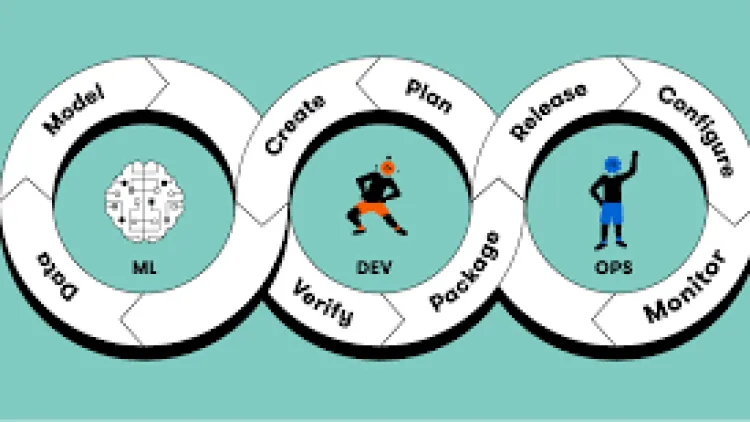
This advanced training equips data engineers with the practical skills required to integrate machine learning workflows into robust, scalable, and production-ready data engineering environments. The course bridges data engineering and MLOps, focusing on how to build automated pipelines that reliably move data from ingestion and preparation through model training, validation, deployment, monitoring, and retraining.
Participants will explore ML pipeline architecture, data and model versioning, feature engineering, workflow orchestration, CI/CD, model serving, automated testing, monitoring, data and model drift, infrastructure automation, and cloud deployment. Emphasis is placed on creating reproducible, observable, secure, and maintainable machine learning pipelines that integrate seamlessly with enterprise data platforms.
Curriculum & Topics
15 Topics | 75 Sessions
-
 Workshop 1.1:
Fundamentals of MLOps for data engineers.
-
Workshop 1.2:
Overview of data versioning, CI/CD, and model monitoring.
-
Workshop 1.3:
Setting up an MLOps development environment.
-
Workshop 1.4:
Introduction to MLOps tools and best practices.
-
Workshop 1.5:
Best practices for MLOps.
-
Workshop 2.1:
Mastering data versioning and feature engineering for machine learning.
-
Workshop 2.2:
Utilizing data version control systems (e.g., DVC).
-
Workshop 2.3:
Implementing feature engineering pipelines.
-
Workshop 2.4:
Designing and building feature stores.
-
Workshop 2.5:
Best practices for data versioning.
-
Workshop 3.1:
Utilizing CI/CD pipelines for machine learning model deployment.
-
Workshop 3.2:
Implementing automated model testing and validation.
-
Workshop 3.3:
Designing and building deployment pipelines.
-
Workshop 3.4:
Optimizing CI/CD for model reproducibility.
-
Workshop 3.5:
Best practices for CI/CD.
-
Workshop 4.1:
Implementing model monitoring and performance tracking.
-
Workshop 4.2:
Utilizing monitoring tools and metrics.
-
Workshop 4.3:
Designing and building performance dashboards.
-
Workshop 4.4:
Optimizing monitoring for model drift detection.
-
Workshop 4.5:
Best practices for model monitoring.
-
Workshop 5.1:
Designing and building scalable machine learning workflows.
-
Workshop 5.2:
Utilizing orchestration tools (e.g., Kubeflow, Airflow).
-
Workshop 5.3:
Implementing distributed model training.
-
Workshop 5.4:
Optimizing workflows for large-scale data processing.
-
Workshop 5.5:
Best practices for scalable workflows.
-
Workshop 6.1:
Optimizing data pipelines for machine learning model training.
-
Workshop 6.2:
Utilizing data transformation and preprocessing.
-
Workshop 6.3:
Implementing data validation and quality checks.
-
Workshop 6.4:
Designing efficient data pipelines.
-
Workshop 6.5:
Best practices for training pipelines.
-
Workshop 7.1:
Debugging common issues in MLOps deployments.
-
Workshop 7.2:
Analyzing model logs and error messages.
-
Workshop 7.3:
Utilizing troubleshooting techniques for problem resolution.
-
Workshop 7.4:
Resolving common deployment errors.
-
Workshop 7.5:
Best practices for troubleshooting.
-
Workshop 8.1:
Implementing model security and access control in MLOps environments.
-
Workshop 8.2:
Utilizing IAM roles and policies.
-
Workshop 8.3:
Designing and building secure model deployments.
-
Workshop 8.4:
Optimizing security for model protection.
-
Workshop 8.5:
Best practices for model security.
-
Workshop 9.1:
Integrating MLOps with various machine learning platforms and tools.
-
Workshop 9.2:
Utilizing cloud-based ML platforms (e.g., AWS SageMaker, Google Vertex AI).
-
Workshop 9.3:
Implementing integration with model serving frameworks.
-
Workshop 9.4:
Optimizing integration for model deployment.
-
Workshop 9.5:
Best practices for integration.
-
Workshop 10.1:
Understanding how to handle model reproducibility and governance.
-
Workshop 10.2:
Utilizing model metadata and lineage tracking.
-
Workshop 10.3:
Implementing model versioning and audit trails.
-
Workshop 10.4:
Designing reproducible model deployments.
-
Workshop 10.5:
Best practices for reproducibility.
-
Workshop 11.1:
Exploring advanced MLOps techniques (model serving, automated retraining).
-
Workshop 11.2:
Utilizing model serving frameworks (e.g., TensorFlow Serving, Seldon Core).
-
Workshop 11.3:
Implementing automated model retraining pipelines.
-
Workshop 11.4:
Designing and building advanced MLOps solutions.
-
Workshop 11.5:
Optimizing advanced techniques for specific applications.
-
Workshop 11.6:
Best practices for advanced techniques.
-
Workshop 12.1:
Implementing MLOps for real-time fraud detection.
-
Workshop 12.2:
Utilizing MLOps for recommendation systems.
-
Workshop 12.3:
Implementing MLOps for natural language processing.
-
Workshop 12.4:
Utilizing MLOps for computer vision applications.
-
Workshop 12.5:
Best practices for real-world applications.
-
Workshop 13.1:
Utilizing MLOps tools and frameworks (MLflow, Kubeflow Pipelines).
-
Workshop 13.2:
Implementing model deployment with specific tools.
-
Workshop 13.3:
Designing and building automated workflows.
-
Workshop 13.4:
Optimizing tool usage for efficient development.
-
Workshop 13.5:
Best practices for tool implementation.
-
Workshop 14.1:
Implementing model performance monitoring.
-
Workshop 14.2:
Utilizing monitoring tools and metrics.
-
Workshop 14.3:
Designing and building performance dashboards.
-
Workshop 14.4:
Optimizing monitoring for real-time insights.
-
Workshop 14.5:
Best practices for monitoring.
-
Workshop 15.1:
Emerging trends in MLOps.
-
Workshop 15.2:
Utilizing AI for MLOps automation.
-
Workshop 15.3:
Implementing MLOps in cloud-native environments.
-
Workshop 15.4:
Best practices for future applications.