15 Topics
 5 Days
 60 Sessions
Programme Overview
Training Description
Crop farmers and growers
Farm managers and supervisors
Agricultural extension officers and advisors
Agricultural inspectors and auditors
Food safety professionals
Quality assurance managers
Agricultural cooperatives and associations
Agribusiness professionals
Rural development practitioners
Agricultural educators
Horticulture professionals
Seed producers and distributors
Students and enthusiasts of sustainable agriculture
Session Objectives
- Understand the principles and benefits of Good Agricultural Practices (GAP). Implement techniques for ensuring food safety in crop production. Understand and comply with GAP standards and regulations. Implement techniques for managing farm operations and record-keeping. Understand the role of traceability systems in GAP. Implement techniques for managing soil health and fertility in GAP. Understand the role of integrated pest management in GAP.
About the Course
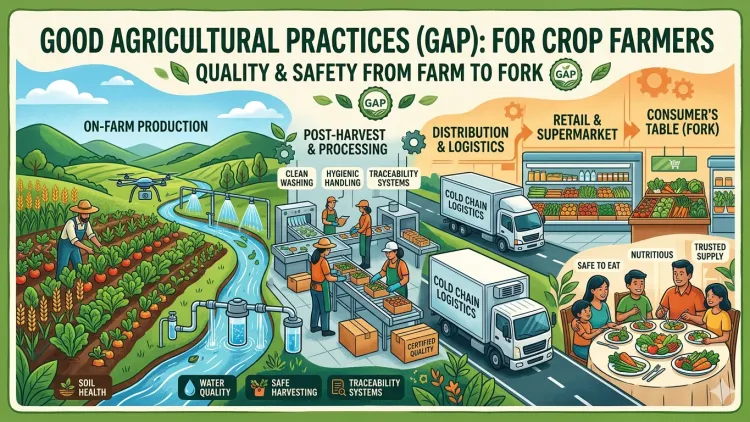
Good Agricultural Practices (GAP) for Crop Farmers equips farmers with the knowledge and skills to implement best practices for safe and sustainable crop production. This course focuses on ensuring food safety, environmental sustainability, and product quality through GAP standards. Participants will learn to manage farm operations, implement traceability systems, and comply with regulatory requirements. By mastering GAP, farmers can enhance market access, improve consumer trust, and ensure long-term farm viability.
Curriculum & Topics
15 Topics | 60 Sessions
-
 Workshop 1.1:
Principles and objectives of GAP.
-
Workshop 1.2:
Understanding the role of GAP in food safety and sustainability.
-
Workshop 1.3:
Benefits of implementing GAP standards.
-
Workshop 1.4:
Historical context and evolution of GAP.
-
Workshop 2.1:
Techniques for preventing contamination.
-
Workshop 2.2:
Implementing hygiene and sanitation practices.
-
Workshop 2.3:
Managing biological, chemical, and physical hazards.
-
Workshop 2.4:
Utilizing risk assessment and control measures.
-
Workshop 3.1:
Understanding national and international GAP standards.
-
Workshop 3.2:
Implementing regulatory requirements and compliance.
-
Workshop 3.3:
Utilizing certification schemes and audits.
-
Workshop 3.4:
Managing documentation and records.
-
Workshop 4.1:
Techniques for planning and managing farm operations.
-
Workshop 4.2:
Implementing traceability systems and record-keeping procedures.
-
Workshop 4.3:
Utilizing farm management software and tools.
-
Workshop 4.4:
Managing input and output records.
-
Workshop 5.1:
Implementing lot identification and tracking.
-
Workshop 5.2:
Utilizing barcode and RFID technologies.
-
Workshop 5.3:
Managing product flow from farm to market.
-
Workshop 5.4:
Benefits of traceability in food safety and quality assurance.
-
Workshop 6.1:
Techniques for maintaining soil health and fertility.
-
Workshop 6.2:
Implementing sustainable soil management practices.
-
Workshop 6.3:
Utilizing organic amendments and fertilizers.
-
Workshop 6.4:
Managing nutrient and water resources.
-
Workshop 7.1:
Implementing IPM strategies for pest and disease control.
-
Workshop 7.2:
Utilizing biological and cultural control methods.
-
Workshop 7.3:
Managing pesticide use and residues.
-
Workshop 7.4:
Benefits of minimizing chemical inputs.
-
Workshop 8.1:
Techniques for efficient water use and irrigation.
-
Workshop 8.2:
Managing water quality and sources.
-
Workshop 8.3:
Implementing water conservation practices.
-
Workshop 8.4:
Utilizing irrigation scheduling and monitoring.
-
Workshop 9.1:
Implementing safe handling procedures for pesticides and fertilizers.
-
Workshop 9.2:
Managing storage facilities and conditions.
-
Workshop 9.3:
Utilizing personal protective equipment (PPE).
-
Workshop 9.4:
Addressing chemical spills and waste disposal.
-
Workshop 10.1:
Techniques for harvesting crops at optimal maturity.
-
Workshop 10.2:
Implementing safe handling and transportation practices.
-
Workshop 10.3:
Managing post-harvest treatments and storage.
-
Workshop 10.4:
Utilizing cold chain management.
-
Workshop 11.1:
Implementing practices for biodiversity conservation.
-
Workshop 11.2:
Managing waste and pollution.
-
Workshop 11.3:
Utilizing energy-efficient technologies.
-
Workshop 11.4:
Benefits of reducing environmental impacts.
-
Workshop 12.1:
Implementing occupational health and safety standards.
-
Workshop 12.2:
Utilizing safety training and awareness programs.
-
Workshop 12.3:
Managing emergency response procedures.
-
Workshop 12.4:
Benefits of creating a safe working environment.
-
Workshop 13.1:
Developing a GAP implementation plan.
-
Workshop 13.2:
Preparing for GAP audits and inspections.
-
Workshop 13.3:
Managing corrective actions and continuous improvement.
-
Workshop 13.4:
Benefits of GAP certification in market access.
-
Workshop 14.1:
Analyzing real-world examples of GAP implementation.
-
Workshop 14.2:
Highlighting best practices and innovative techniques.
-
Workshop 14.3:
Documenting economic and environmental impacts.
-
Workshop 14.4:
Farmer testimonials and site visits.
-
Workshop 15.1:
Exploring emerging trends and innovations in GAP.
-
Workshop 15.2:
Integrating new technologies and data management systems.
-
Workshop 15.3:
Adapting to evolving market demands and regulatory changes.
-
Workshop 15.4:
Building sustainable and resilient agricultural systems through GAP.