7 Topics
 5 Days
 35 Sessions
Programme Overview
Training Description
School Principals/Head Teachers and School Administrators
Teachers and Curriculum Developers
Ministry of Education Officials and Policy Makers
Disaster Management Professionals working with the education sector
School Safety Committee members and Maintenance Staff
NGO/INGO Staff focusing on child protection and education in emergencies
Local Community Leaders involved in school disaster planning
Session Objectives
- Strengthen understanding of resilient schools and DRR education. Increase capacity to integrate DRR into national education policies and plans. Improve the resilience of education facilities through technical and non-technical guidance. Support the development and implementation of School Disaster Management plans. Enhance capacity of educators to integrate DRR education into curricula and classroom delivery. Highlight the importance of multi-hazard assessments for all three pillars of the CSSF
About the Course
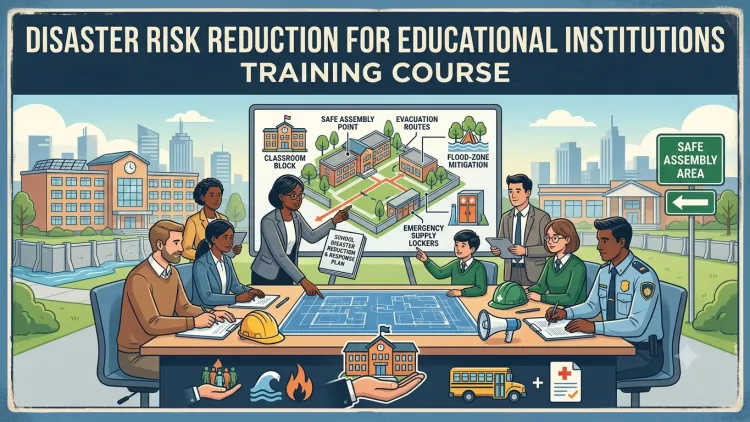
Build practical capacity to safeguard schools and protect learning continuity. Aligned with the Comprehensive School Safety Framework (CSSF) and the Sendai Framework, this course equips educators, administrators, and emergency coordinators to evaluate campus risks, execute school safety plans, and manage emergency responses. Participants will learn to integrate disaster risk reduction into both institutional governance and classroom learning to foster long-term community resilience.
Curriculum & Topics
7 Topics | 35 Sessions
-
 Workshop 1.1:
Defining the specific risks and vulnerabilities of schools, colleges, and universities for your module.
-
Workshop 1.2:
Exploring common hazards (natural, technological, human-caused) impacting educational settings.
-
Workshop 1.3:
Understanding the unique challenges of protecting large populations of students and staff.
-
Workshop 1.4:
Overview of the importance of safe infrastructure and learning environments.
-
Workshop 1.5:
The imperative for a holistic approach to DRR in education.
-
Workshop 2.1:
Learning the core concepts of Disaster Risk Reduction (DRR) relevant to the education sector for your module.
-
Workshop 2.2:
Understanding the relationship between DRR, safety, and educational continuity.
-
Workshop 2.3:
Exploring international frameworks and guidelines for school safety.
-
Workshop 2.4:
The role of policies and regulations in promoting DRR in educational institutions.
-
Workshop 2.5:
Building a culture of safety and preparedness.
-
Workshop 3.1:
Methodologies for conducting thorough hazard identification and risk assessment for school campuses for your module.
-
Workshop 3.2:
Analyzing structural and non-structural vulnerabilities within school buildings.
-
Workshop 3.3:
Identifying potential threats to student and staff safety.
-
Workshop 3.4:
Utilizing checklists and audit tools for comprehensive risk evaluation.
-
Workshop 3.5:
Prioritizing risk reduction actions based on assessment findings.
-
Workshop 4.1:
Developing comprehensive emergency preparedness plans tailored for educational institutions for your module.
-
Workshop 4.2:
Establishing clear roles, responsibilities, and communication protocols for staff and students.
-
Workshop 4.3:
Planning for various scenarios (e.g., fire, earthquake, active threat, medical emergency).
-
Workshop 4.4:
Creating detailed evacuation routes, assembly points, and reunification procedures.
-
Workshop 4.5:
The importance of cross-functional team involvement in plan development.
-
Workshop 5.1:
Understanding structural mitigation measures for enhancing school building safety for your module.
-
Workshop 5.2:
Implementing non-structural mitigation (e.g., securing furniture, emergency kits, first aid supplies).
-
Workshop 5.3:
Strategies for fire prevention, earthquake bracing, and hazardous materials management.
-
Workshop 5.4:
Designing safe zones and shelter-in-place procedures.
-
Workshop 5.5:
The role of facility maintenance in reducing risks.
-
Workshop 6.1:
Designing and conducting effective emergency drills and exercises for students and staff for your module.
-
Workshop 6.2:
Learning techniques for realistic scenario-based training.
-
Workshop 6.3:
Strategies for clear and calm crisis communication with students, parents, and the wider community.
-
Workshop 6.4:
Utilizing mass notification systems and emergency alerts.
-
Workshop 6.5:
Managing misinformation and fear during a crisis.
-
Workshop 7.1:
Ensuring educational continuity through contingency plans for alternative learning environments for your module.
-
Workshop 7.2:
Strategies for managing academic schedules and curriculum post-disaster.
-
Workshop 7.3:
Providing psychosocial support and trauma-informed care for students and staff.
-
Workshop 7.4:
Planning for long-term recovery and reconstruction of affected educational facilities.
-
Workshop 7.5:
Integrating lessons learned into a continuous improvement cycle for DRR.