8 Topics
 5 Days
 40 Sessions
Programme Overview
Training Description
Session Objectives
- Understand the key drivers of digital transformation in budgeting. Implement data analytics and business intelligence for better forecasting. Utilize artificial intelligence and machine learning to create predictive models. Automate routine budgeting tasks to free up time for strategic analysis. Design and deploy cloud-based budgeting and planning solutions.
About the Course
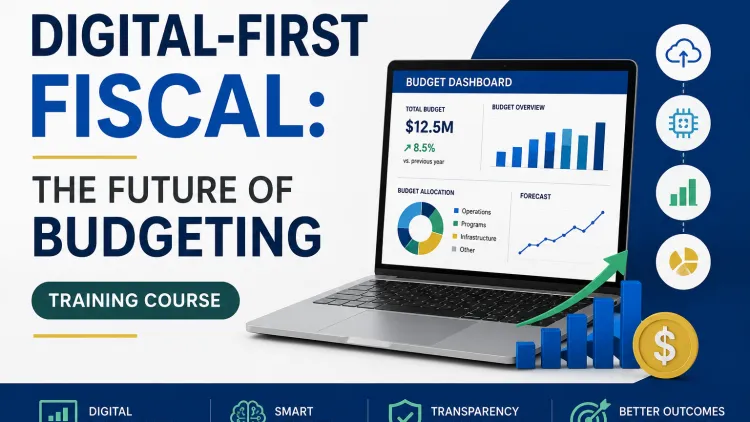
Digital-First Fiscal: The Future of Budgeting is a forward-looking training course designed to help finance, budgeting, and planning professionals understand and apply emerging digital technologies and modern approaches that are transforming the budgeting function.The course explores the evolution from traditional, largely manual budgeting toward digital, connected, automated, data-driven, and increasingly intelligent budgeting environments. Participants will examine how cloud platforms, artificial intelligence, automation, business intelligence, real-time data, advanced analytics, digital collaboration, and integrated financial systems can improve budget preparation, forecasting, monitoring, and decision-makingThe training also addresses the organizational and governance implications of digital budgeting, including data quality, cybersecurity, technology adoption, process redesign, digital skills, change management, and responsible use of AI. Participants will develop practical strategies for building a future-ready budgeting function that is more agile, responsive, transparent, and efficient..
Curriculum & Topics
8 Topics | 40 Sessions
-
 Workshop 1.1:
Defining the digital age of financial management.
-
Workshop 1.2:
The shift from traditional to modern budgeting.
-
Workshop 1.3:
Key technologies driving change: AI, big data, cloud computing.
-
Workshop 1.4:
The changing role of the finance professional.
-
Workshop 1.5:
A roadmap for digital transformation in the finance office.
-
Workshop 2.1:
The importance of data quality and integrity.
-
Workshop 2.2:
Using data warehousing and business intelligence tools.
-
Workshop 2.3:
Building a framework for key performance indicators (KPIs).
-
Workshop 2.4:
Creating dashboards for real-time fiscal monitoring.
-
Workshop 2.5:
Performing advanced variance and trend analysis.
-
Workshop 3.1:
The fundamentals of AI and ML for financial applications.
-
Workshop 3.2:
Predictive modeling for revenue and expense forecasting.
-
Workshop 3.3:
Using machine learning to identify budget anomalies.
-
Workshop 3.4:
Automated scenario planning and sensitivity analysis.
-
Workshop 3.5:
Case studies on AI-driven financial models.
-
Workshop 4.1:
Identifying opportunities for automation in the budget cycle.
-
Workshop 4.2:
Implementing robotic process automation (RPA) for repetitive tasks.
-
Workshop 4.3:
Designing automated workflows for approvals and reporting.
-
Workshop 4.4:
The role of smart contracts in financial governance.
-
Workshop 4.5:
Measuring the ROI of automation initiatives.
-
Workshop 5.1:
The benefits of moving budgeting to the cloud.
-
Workshop 5.2:
Evaluating and selecting a cloud-based solution.
-
Workshop 5.3:
Integrating cloud platforms with existing enterprise systems.
-
Workshop 5.4:
Best practices for platform implementation and user adoption.
-
Workshop 5.5:
Security and compliance in a cloud environment.
-
Workshop 6.1:
The new risks of digital financial systems.
-
Workshop 6.2:
Developing a robust cybersecurity strategy for finance.
-
Workshop 6.3:
Implementing data governance policies and controls.
-
Workshop 6.4:
Ensuring compliance with global data protection regulations.
-
Workshop 6.5:
Responding to and recovering from a data breach.
-
Workshop 7.1:
Moving away from the rigid annual budget.
-
Workshop 7.2:
The principles of rolling forecasts and zero-based budgeting.
-
Workshop 7.3:
Designing a flexible budget that adapts to market changes.
-
Workshop 7.4:
Fostering a culture of continuous planning and feedback.
-
Workshop 7.5:
The role of dynamic planning in strategic decision-making.
-
Workshop 8.1:
The power of visual storytelling with financial data.
-
Workshop 8.2:
Using tools like Tableau and Power BI for fiscal reporting.
-
Workshop 8.3:
Designing interactive dashboards for stakeholders.
-
Workshop 8.4:
Best practices for presenting complex data clearly.
-
Workshop 8.5:
Communicating insights for maximum impact.