7 Topics
 5 Days
 35 Sessions
Programme Overview
Training Description
- Agricultural and rural development professionals
- Farmers and agricultural producers
- Agronomists and soil scientists
- Agroforestry and forestry professionals
- Environmental and natural resource management specialists
- Climate change mitigation and adaptation professionals
- Carbon project developers and consultants
- Land-use and landscape planners
- Ecosystem restoration practitioners
- Conservation and biodiversity specialists
- Agricultural extension officers
- Government agriculture, forestry, and environment officials
Session Objectives
- Explain the fundamental principles of the global carbon cycle and the role of carbon sequestration. Identify and assess the potential for carbon storage in various rural ecosystems. Understand and apply best practices for enhancing soil carbon sequestration in agricultural lands. Learn techniques for increasing carbon uptake and storage in forests and woodlands. Explore the role of agroforestry and other integrated systems in carbon sequestration.
About the Course
The Carbon Sequestration, Agroforestry and Sustainable Rural Land Management Training Course provides participants with practical knowledge and skills for enhancing carbon storage in soils, vegetation, and agricultural landscapes while supporting climate change mitigation, ecosystem restoration, and sustainable rural development.
Participants will learn how to identify carbon sequestration opportunities, assess land-use practices, select appropriate interventions, and integrate carbon management into agricultural and rural development plans. The training also introduces approaches to carbon measurement, monitoring, reporting, verification (MRV), carbon projects, carbon markets, and climate finance.
The course emphasizes climate resilience, biodiversity conservation, sustainable livelihoods, community participation, and responsible land management, enabling participants to develop practical approaches that link carbon sequestration with long-term rural development.
Curriculum & Topics
7 Topics | 35 Sessions
-
 Workshop 1.1:
Understanding the Earth's carbon cycle and human impacts.
Workshop 1.1:
Understanding the Earth's carbon cycle and human impacts.
-
Workshop 1.2:
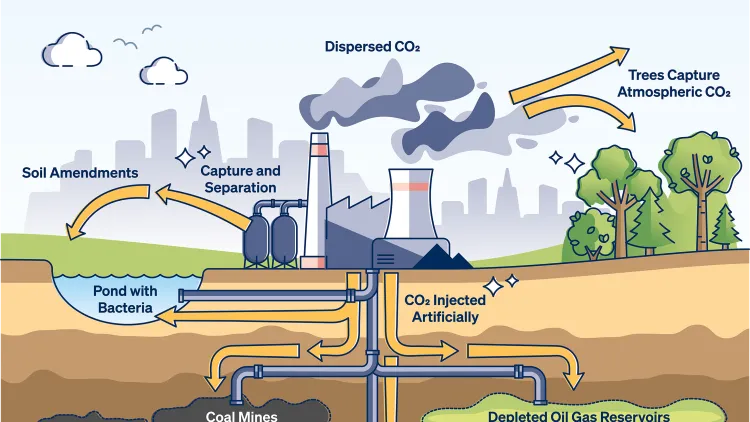
Defining carbon sequestration and its importance in climate change mitigation.
-
Workshop 1.3:
Exploring how natural systems act as carbon sinks; this module covers foundational concepts.
-
Workshop 1.4:
Differentiating between various forms of carbon storage in landscapes.
-
Workshop 1.5:
The role of photosynthesis and biomass in carbon capture; this module explains the biological process.
-
Workshop 2.1:
Principles of soil health and its link to carbon storage.
-
Workshop 2.2:
Implementing conservation tillage and no-till farming practices.
-
Workshop 2.3:
Utilizing cover crops and crop rotations to enhance soil organic carbon; this module focuses on agricultural practices.
-
Workshop 2.4:
Managing grazing lands for improved soil health and carbon; this module addresses livestock systems.
-
Workshop 2.5:
The role of organic amendments and biochar in soil carbon sequestration; this module explores input materials.
-
Workshop 3.1:
Understanding carbon dynamics in forest ecosystems.
-
Workshop 3.2:
Techniques for increasing carbon storage through afforestation and reforestation.
-
Workshop 3.3:
Sustainable forest management practices for enhanced carbon uptake; this module covers forestry techniques.
-
Workshop 3.4:
Assessing carbon in different forest pools (biomass, deadwood, litter, soils).
-
Workshop 3.5:
The impact of disturbances (fire, pests) on forest carbon; this module addresses risks.
-
Workshop 4.1:
Principles of agroforestry and its benefits for carbon sequestration.
-
Workshop 4.2:
Designing and implementing agroforestry systems for carbon storage; this module focuses on system design.
-
Workshop 4.3:
Integrating trees and shrubs into agricultural landscapes.
-
Workshop 4.4:
Silvopasture and its potential for combined carbon and livestock benefits.
-
Workshop 4.5:
Case studies of successful agroforestry carbon projects; this module provides real-world examples.
-
Workshop 5.1:
Introduction to methods for measuring carbon stocks in different pools.
-
Workshop 5.2:
Techniques for monitoring changes in carbon over time; this module covers tracking.
-
Workshop 5.3:
Understanding MRV protocols and standards for carbon projects.
-
Workshop 5.4:
Utilizing remote sensing and GIS for carbon estimation and monitoring.
-
Workshop 5.5:
Ensuring accuracy and transparency in carbon accounting; this module emphasizes data integrity.
-
Workshop 6.1:
Overview of compliance and voluntary carbon markets.
-
Workshop 6.2:
How carbon credits are generated and traded from rural land use.
-
Workshop 6.3:
Opportunities and challenges for rural landowners participating in carbon markets; this module explores market access.
-
Workshop 6.4:
Accessing finance and investment for carbon sequestration projects.
-
Workshop 6.5:
Understanding contractual agreements and permanence requirements; this module covers market mechanics.
-
Workshop 7.1:
Analyzing government policies that support carbon sequestration in rural areas.
-
Workshop 7.2:
Exploring financial incentives and payment for ecosystem services programs; this module covers financial support.
-
Workshop 7.3:
The importance of community engagement in carbon sequestration projects.
-
Workshop 7.4:
Addressing land tenure and equity issues in carbon initiatives; this module highlights social considerations.
-
Workshop 7.5:
Developing strategies for effective stakeholder collaboration; this module focuses on partnerships.