15 Topics
 10 Days
Programme Overview
Training Description
Who Should Attend
This course is ideal for;
- Sustainability Managers
- Environmental Consultants
- Quality and Auditing Professionals
- Supply Chain Managers
- Corporate ESG (Environmental, Social, Governance) Teams
- Product Development and R&D Specialists
- Life Cycle Assessment Practitioners
- Environmental Engineers
- Public Sector Employees
- Investors and Financial Analysts
Session Objectives
- Master the core principles of the ISO 14067 standard.
- Learn to conduct a comprehensive product life cycle assessment for carbon footprinting.
- Understand the key differences between a product and organizational carbon footprint.
- Grasp the complexities of data collection and quality management.
- Develop proficiency in calculating carbon footprint results for a product.
- Explore best practices for defining system boundaries and functional units.
- Learn about robust approaches to verification and external reporting.
- Identify the critical legal and regulatory frameworks for product claims.
- Develop skills in using carbon footprint data for strategic decision-making.
- Formulate strategies for a data-driven approach to product sustainability.
About the Course
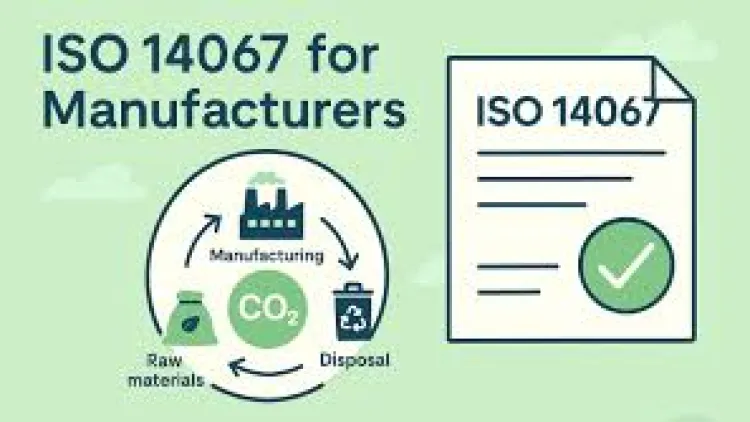
As global regulations and consumer demands call for transparent climate reporting, businesses face increasing pressure to quantify the environmental impact of their products across the entire life cycle. Without standardized measurement methodologies, environmental claims risk being inconsistent, unverified, or dismissed as greenwashing. Our ISO 14067: Product Carbon Footprint (PCF) Quantification & Reporting Training Course solves this compliance and credibility challenge by equipping professionals with a rigorous, globally recognized framework for quantifying and reporting product carbon footprints. Guided by sustainability and Life Cycle Assessment (LCA) experts, participants learn step-by-step how to define system boundaries, collect primary activity data, apply emission factors, and perform life-cycle greenhouse gas calculations. By bridging standard compliance with value-chain decarbonization, this program prepares sustainability leads, quality managers, and supply chain directors to drive verifiable environmental claims, pass external audits, and gain a distinct competitive advantage in green markets.
Curriculum & Topics
15 Topics | 10 Days
-
 Subtopic 1.1:
The importance of measuring a product's carbon footprint
Subtopic 1.1:
The importance of measuring a product's carbon footprint
-
Subtopic 1.2:
The role of ISO standards in sustainability reporting
-
Subtopic 1.3:
Key concepts: greenhouse gases (GHG), CO2e, and life cycle
-
Subtopic 1.4:
The difference between product and corporate carbon footprint
-
Subtopic 1.5:
The business case for ISO 14067 compliance
-
Subtopic 2.1:
Principles and requirements of the standard
-
Subtopic 2.2:
An overview of the ISO 14060 family of standards
-
Subtopic 2.3:
The relationship between ISO 14067 and LCA standards (ISO 14040, 14044)
-
Subtopic 2.4:
The role of a clear and focused research question
-
Subtopic 2.5:
The scope and limitations of ISO 14067
-
Subtopic 3.1:
Defining the product and its intended application
-
Subtopic 3.2:
Setting the goal and scope of the study
-
Subtopic 3.3:
Determining the system boundaries (cradle-to-gate vs. cradle-to-grave)
-
Subtopic 3.4:
The importance of a "risk and mitigation" plan
-
Subtopic 3.5:
Establishing the functional unit
-
Subtopic 4.1:
Data collection principles and methods
-
Subtopic 4.2:
Primary vs. secondary data sources
-
Subtopic 4.3:
Data quality requirements and uncertainty
-
Subtopic 4.4:
The importance of a simple scorecard and a dashboard
-
Subtopic 4.5:
Mass and energy balance
-
Subtopic 5.1:
The concept of an emission factor
-
Subtopic 5.2:
Sourcing and selecting appropriate databases
-
Subtopic 5.3:
The role of a "data story map"
-
Subtopic 5.4:
Understanding the limitations of available data
-
Subtopic 5.5:
The importance of a program's theory of change
-
Subtopic 6.1:
Methodologies for calculating GHG emissions
-
Subtopic 6.2:
The complexities of allocation (e.g., co-products, recycling)
-
Subtopic 6.3:
The role of a "stakeholder analysis"
-
Subtopic 6.4:
Using software tools for calculation
-
Subtopic 6.5:
The importance of a clear and compelling KPI
-
Subtopic 7.1:
The single impact category: climate change
-
Subtopic 7.2:
The concept of a global warming potential (GWP)
-
Subtopic 7.3:
The role of a simple scorecard and a dashboard
-
Subtopic 7.4:
Understanding characterization and normalization
-
Subtopic 7.5:
The importance of a clear and consistent reporting style
-
Subtopic 8.1:
Interpreting the results of the study
-
Subtopic 8.2:
Identifying the main emission hotspots
-
Subtopic 8.3:
The role of a "risk and mitigation" plan
-
Subtopic 8.4:
Using results to inform reduction strategies
-
Subtopic 8.5:
The importance of a clear and focused research question
-
Subtopic 9.1:
Requirements for a clear and transparent report
-
Subtopic 9.2:
The role of a "data story map"
-
Subtopic 9.3:
The use of a final report for internal and external purposes
-
Subtopic 9.4:
Best practices for communicating claims and labels
-
Subtopic 9.5:
The challenges of greenwashing
-
Subtopic 10.1:
The importance of third-party verification
-
Subtopic 10.2:
The process of a verification audit
-
Subtopic 10.3:
The role of a "program's theory of change"
-
Subtopic 10.4:
Ensuring the credibility of carbon footprint claims
-
Subtopic 10.5:
The benefits of external assurance
-
Subtopic 11.1:
Engaging suppliers in data collection
-
Subtopic 11.2:
The role of Scope 3 emissions in product footprinting
-
Subtopic 11.3:
The importance of a "stakeholder analysis"
-
Subtopic 11.4:
Reducing supply chain emissions
-
Subtopic 11.5:
Supplier collaboration and incentives
-
Subtopic 12.1:
Carbon footprinting for services
-
Subtopic 12.2:
Comparative assertions and product comparisons
-
Subtopic 12.3:
The role of a "risk and mitigation" plan
-
Subtopic 12.4:
The use of digital twins in carbon footprinting
-
Subtopic 12.5:
The intersection with other standards (e.g., ISO 14064, ISO 14069)
-
Subtopic 13.1:
Identifying and prioritizing reduction opportunities
-
Subtopic 13.2:
The role of a "clear and compelling KPI"
-
Subtopic 13.3:
Implementing changes in material sourcing and design
-
Subtopic 13.4:
Improving energy efficiency and logistics
-
Subtopic 13.5:
The role of a "data story map"
-
Subtopic 14.1:
Case study: A food product carbon footprint
-
Subtopic 14.2:
Case study: An electronics product carbon footprint
-
Subtopic 14.3:
Case study: A fashion product carbon footprint
-
Subtopic 14.4:
Lessons learned from real-world examples
-
Subtopic 14.5:
The role of a "clear and consistent reporting style"
-
Subtopic 15.1:
Overview of common LCA software
-
Subtopic 15.2:
The use of carbon accounting platforms
-
Subtopic 15.3:
The importance of a "simple scorecard and a dashboard"
-
Subtopic 15.4:
Practical exercises with software
-
Subtopic 15.5:
The importance of a "clear and focused research question"