7 Topics
 5 Days
Programme Overview
Training Description
Who Should Attend
• Government Agency Directors & Managers
• Public Sector IT & Operations Managers
• Emergency Management Coordinators
• Public Information Officers
• Risk Management Professionals in Government
• Compliance & Audit Officers in Public Agencies
• Department Heads overseeing critical public services
• Business Continuity Planners for Government
Session Objectives
- Learn how to conduct a comprehensive Business Impact Analysis (BIA) to identify critical public services.
- Master methodologies for assessing risks and vulnerabilities specific to public sector operations.
- Develop skills in formulating effective business continuity strategies and recovery options.
- Understand the components of a robust Business Continuity Plan (BCP) for government entities.
- Learn strategies for effective incident response and crisis management in public agencies.
- Explore best practices for internal and external communication during public sector disruptions.
About the Course
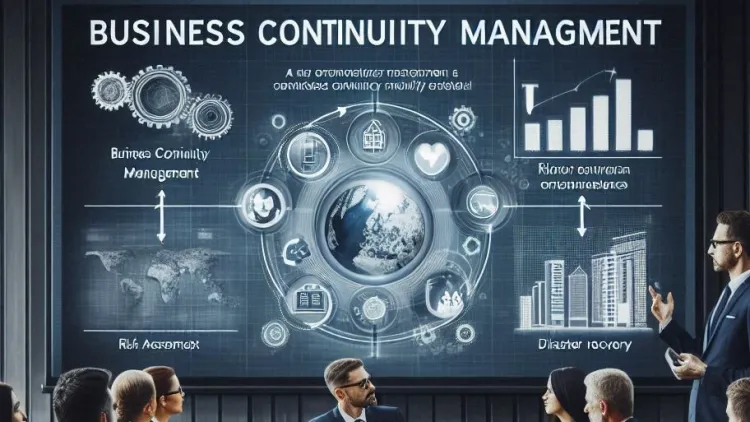
Safeguard essential public services, protect data security, and preserve public trust during crises. This specialized training provides public sector professionals with a systematic framework for Business Continuity Management (BCM)—from risk identification and Business Impact Analysis (BIA) to recovery execution and incident response.
Designed specifically for the unique demands of public administration, participants will learn to prioritize critical functions, establish Recovery Time Objectives (RTOs/RPOs), manage regulatory compliance, and execute clear stakeholder communications under pressure.
Through practical exercises and scenario testing (tabletop and full-scale simulations), you will master how to structure, test, and maintain an actionable Business Continuity Plan (BCP) that ensures organizational resilience and uninterrupted government operations.
Curriculum & Topics
7 Topics | 5 Days
-
 Subtopic 1.1:
Defining Business Continuity Management (BCM) and its relevance to public agencies.
Subtopic 1.1:
Defining Business Continuity Management (BCM) and its relevance to public agencies.
-
Subtopic 1.2:
Understanding the importance of maintaining essential government functions during disruptions.
-
Subtopic 1.3:
Exploring the benefits of a robust BCM program for public trust and service delivery.
-
Subtopic 1.4:
Overview of the BCM lifecycle: policy, analysis, design, implementation, validation.
-
Subtopic 1.5:
Key drivers for BCM adoption in the public sector.
-
Subtopic 2.1:
Learning methodologies for conducting a comprehensive Business Impact Analysis (BIA) for your module.
-
Subtopic 2.2:
Identifying critical public services and their dependencies.
-
Subtopic 2.3:
Determining Recovery Time Objectives (RTOs) and Recovery Point Objectives (RPOs) for public functions.
-
Subtopic 2.4:
Assessing the impact of disruptions on service delivery, reputation, and compliance.
-
Subtopic 2.5:
Prioritizing public services based on criticality.
-
Subtopic 3.1:
Conducting systematic risk assessments to identify threats to public agency operations.
-
Subtopic 3.2:
Evaluating the likelihood and potential impact of various risks.
-
Subtopic 3.3:
Developing strategies for risk mitigation and prevention.
-
Subtopic 3.4:
Understanding common public sector-specific risks (e.g., cyberattacks, public health crises).
-
Subtopic 4.1:
Formulating effective business continuity strategies for critical public agency functions.
-
Subtopic 4.2:
Exploring various recovery options (e.g., alternate sites, redundant systems, remote work).
-
Subtopic 4.3:
Designing contingency plans for personnel, facilities, technology, and data.
-
Subtopic 4.4:
Understanding resource requirements for implementing continuity strategies.
-
Subtopic 4.5:
Aligning strategies with agency mission and public service mandates.
-
Subtopic 5.1:
Structuring and developing a comprehensive Business Continuity Plan (BCP) for public agencies.
-
Subtopic 5.2:
Documenting roles, responsibilities, and procedures for plan activation.
-
Subtopic 5.3:
Creating clear communication trees and contact lists for emergency response.
-
Subtopic 5.4:
Integrating incident response protocols into the BCP.
-
Subtopic 5.5:
Ensuring the BCP is actionable and easily understandable by all personnel.
-
Subtopic 6.1:
Establishing effective incident response teams and protocols for public agencies.
-
Subtopic 6.2:
Understanding the coordination between incident response, crisis management, and BCM.
-
Subtopic 6.3:
Managing the immediate aftermath of a disruptive event.
-
Subtopic 6.4:
Implementing strategies for rapid assessment and stabilization of operations.
-
Subtopic 6.5:
Best practices for decision-making under pressure in a public sector crisis.
-
Subtopic 7.1:
Designing and conducting various BCM exercises (e.g., tabletop, functional, full-scale) for your module.
-
Subtopic 7.2:
Evaluating the effectiveness of the Business Continuity Plan (BCP) and identifying gaps.
-
Subtopic 7.3:
Implementing a continuous improvement cycle based on lessons learned from exercises.
-
Subtopic 7.4:
Establishing a schedule for regular review, update, and maintenance of BCM documentation.
-
Subtopic 7.5:
Fostering a culture of preparedness and ongoing training within public agencies.