8 Topics
 5 Days
 40 Sessions
Programme Overview
Training Description
- Management accountants
- Financial analysts
- Treasury professionals
- Departmental budget holders
- Business-unit managers
- Project and programme managers
- Procurement and operations managers
- Performance-management professionals
- Risk-management professionals
- Strategic planning professionals
- Senior executives responsible for financial performance
Session Objectives
- Master the core concepts of budgetary variance analysis. Implement a system for continuous financial monitoring. Identify the root causes of both favorable and unfavorable variances. Leverage technology and dashboards for real-time reporting. Develop a robust framework for taking timely corrective action. Use variance analysis to drive accountability and performance.
About the Course
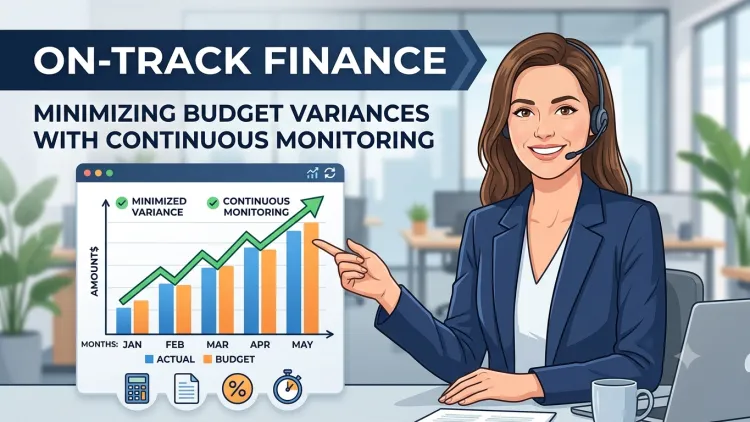
On-Track Finance: Minimizing Budget Variances with Continuous Monitoring is a practical professional training course designed to equip finance, budgeting, FP&A, accounting, and management professionals with the skills required to monitor financial performance continuously, identify budget deviations early, and implement timely corrective action.
The course moves beyond traditional periodic budget reviews by introducing continuous monitoring, real-time variance analysis, rolling forecasts, financial dashboards, early-warning indicators, and proactive performance management. Participants will learn how to identify the causes of budget variances, distinguish controllable from uncontrollable deviations, establish monitoring thresholds, and develop corrective measures that keep financial performance aligned with organizational objectives.
Curriculum & Topics
8 Topics | 40 Sessions
-
 Workshop 1.1:
The definition and types of budget variances.
Workshop 1.1:
The definition and types of budget variances.
-
Workshop 1.2:
The difference between flexible and static budgets.
-
Workshop 1.3:
The purpose and benefits of variance analysis.
-
Workshop 1.4:
Common causes of budgetary deviations.
-
Workshop 1.5:
The strategic impact of unmanaged variances.
-
Workshop 2.1:
The shift from reactive to proactive financial management.
-
Workshop 2.2:
A step-by-step guide to implementing a continuous monitoring system.
-
Workshop 2.3:
Key performance indicators (KPIs) for real-time tracking.
-
Workshop 2.4:
The role of periodic review cycles (e.g., weekly, bi-weekly).
-
Workshop 2.5:
Integrating monitoring with the broader budget process.
-
Workshop 3.1:
Calculating and interpreting sales volume and price variances.
-
Workshop 3.2:
Analyzing material usage and price variances.
-
Workshop 3.3:
Diagnosing labor rate and efficiency variances.
-
Workshop 3.4:
Decomposing overhead variances for greater insight.
-
Workshop 3.5:
Practical exercises on calculating and explaining variances.
-
Workshop 4.1:
Techniques for identifying the underlying causes of variances.
-
Workshop 4.2:
Differentiating between controllable and uncontrollable factors.
-
Workshop 4.3:
Using a "5 Whys" approach to get to the root of the problem.
-
Workshop 4.4:
The role of departmental and cross-functional teams in analysis.
-
Workshop 4.5:
Developing a corrective action plan.
-
Workshop 5.1:
Overview of financial software and business intelligence (BI) tools.
-
Workshop 5.2:
Designing a real-time budget performance dashboard.
-
Workshop 5.3:
The benefits of automated reporting and alerts.
-
Workshop 5.4:
Integrating monitoring with enterprise resource planning (ERP) systems.
-
Workshop 5.5:
Practical lab session on creating a variance dashboard.
-
Workshop 6.1:
Using current variance trends to forecast future performance.
-
Workshop 6.2:
The link between monitoring and strategic decision-making.
-
Workshop 6.3:
Implementing a formal corrective action process.
-
Workshop 6.4:
The importance of timely and decisive action.
-
Workshop 6.5:
Case studies on successful variance mitigation.
-
Workshop 7.1:
The role of budget owners and departmental leaders.
-
Workshop 7.2:
Communicating variances and action plans to stakeholders.
-
Workshop 7.3:
The importance of a non-punitive approach to budget deviations.
-
Workshop 7.4:
Using variance analysis to motivate and empower teams.
-
Workshop 7.5:
Best practices for reporting to senior leadership and boards.
-
Workshop 8.1:
A comprehensive capstone project on a company with budget variances.
-
Workshop 8.2:
Participants work in groups to implement a continuous monitoring plan.
-
Workshop 8.3:
Presenting your plan for corrective action.
-
Workshop 8.4:
A final Q&A and best practice sharing session.
-
Workshop 8.5:
Developing a personal action plan for your organization.