8 Topics
 5 Days
 40 Sessions
Programme Overview
Training Description
- Strategic Planning Professionals
- Business Intelligence and Data Analysts
- Performance Management Professionals
- Department Heads and Budget Holders
- Project and Programme Managers
- Public Sector Finance Professionals
- NGO and Development Finance Professionals
- Investor Relations and Corporate Reporting Professionals
- Professionals responsible for budget presentations, financial reporting, management reporting, data analysis, and communicating financial information to decision-makers
Session Objectives
- Master the principles of data storytelling. Identify the key narrative points in financial data. Design effective and persuasive data visualizations. Structure a budget presentation to tell a clear story. Tailor your message to different stakeholder audiences. Use qualitative context to enhance quantitative data
About the Course
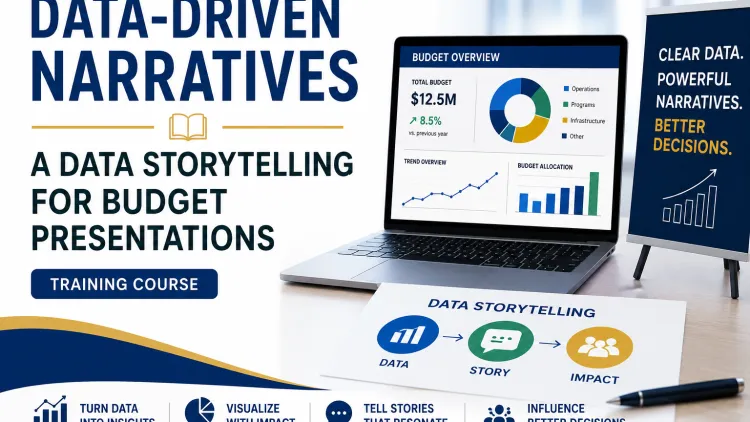
Data-Driven Narratives: Data Storytelling for Budget Presentations is a practical training course designed to help finance, budgeting, planning, and management professionals transform complex financial information into clear, compelling, and decision-oriented budget presentations.
The course focuses on combining financial analysis, visual communication, narrative techniques, and audience engagement to make budget information easier to understand and act upon. Participants will learn how to identify the most important insights in budget data, structure persuasive financial narratives, select effective charts and visualizations, explain variances and trends, and communicate financial recommendations to executives, boards, management teams, legislators, donors, and other stakeholders.Through practical exercises and presentation simulations, participants will develop the ability to move beyond simply presenting numbers and instead tell the story behind the numbers, highlighting financial performance, risks, opportunities, resource requirements, and recommended actions.
Curriculum & Topics
8 Topics | 40 Sessions
-
 Workshop 1.1:
Understanding the core components of a data story.
Workshop 1.1:
Understanding the core components of a data story.
-
Workshop 1.2:
The difference between data reporting and data storytelling.
-
Workshop 1.3:
The psychology of persuasion and decision-making.
-
Workshop 1.4:
Case studies of successful and unsuccessful budget presentations.
-
Workshop 1.5:
The role of data in building trust and credibility.
-
Workshop 2.1:
Identifying your stakeholders and their unique priorities.
-
Workshop 2.2:
Tailoring your message for executives, department leads, and others.
-
Workshop 2.3:
How to anticipate questions and objections.
-
Workshop 2.4:
Using empathy to connect with your audience.
-
Workshop 2.5:
Conducting a stakeholder analysis for a budget proposal.
-
Workshop 3.1:
Principles of effective data visualization for finance.
-
Workshop 3.2:
Choosing the right chart type to tell your story.
-
Workshop 3.3:
Common mistakes to avoid in data visualization.
-
Workshop 3.4:
Using design elements to highlight key insights.
-
Workshop 3.5:
Hands-on practice creating compelling visuals.
-
Workshop 4.1:
Developing a clear beginning, middle, and end for your presentation.
-
Workshop 4.2:
The art of the hook: starting with a strong opening.
-
Workshop 4.3:
Building a compelling case for your budget request.
-
Workshop 4.4:
Using a "call to action" to drive a decision.
-
Workshop 4.5:
Techniques for making your numbers unforgettable.
-
Workshop 5.1:
A step-by-step guide to building a presentation flow.
-
Workshop 5.2:
Creating a title and agenda that grab attention.
-
Workshop 5.3:
Best practices for slide design and content.
-
Workshop 5.4:
Integrating qualitative data and anecdotes.
-
Workshop 5.5:
Practice presentations with peer feedback.
-
Workshop 6.1:
Using logical arguments and supporting evidence.
-
Workshop 6.2:
Tapping into emotional drivers without being manipulative.
-
Workshop 6.3:
The power of contrast and comparison.
-
Workshop 6.4:
Mastering your body language and vocal delivery.
-
Workshop 6.5:
Techniques for building consensus and support.
-
Workshop 7.1:
Preparing for the Q&A session.
-
Workshop 7.2:
Strategies for addressing difficult questions.
-
Workshop 7.3:
How to respond to skepticism and pushback.
-
Workshop 7.4:
The importance of staying calm and confident.
-
Workshop 7.5:
Techniques for turning objections into opportunities.
-
Workshop 8.1:
Introduction to interactive dashboards and data tools.
-
Workshop 8.2:
The use of animation and transitions in presentations.
-
Workshop 8.3:
Exploring advanced charting techniques.
-
Workshop 8.4:
Leveraging a presentation's appendix for a deeper dive.
-
Workshop 8.5:
Best practices for virtual and remote budget presentations.