15 Topics
 5 Days
 75 Sessions
Programme Overview
Training Description
Farmers and Agripreneurs
Food Processors and Manufacturers
Agricultural Extension Officers
Agribusiness Investors
Marketing and Sales Professionals in the Agri-food Sector
Researchers and Academics in Food Science and Agriculture
Individuals seeking to start or expand an agro-processing busines
Session Objectives
- Understand the principles and importance of agro-processing and value addition in the agricultural value chain. Gain comprehensive knowledge of various food processing technologies applicable to different agricultural commodities. Learn the steps involved in developing innovative and market-driven value-added food products. Master techniques for extending the shelf life and improving the quality of processed agricultural products. Understand food safety regulations and quality assurance standards in agro-processing. Develop effective packaging and labeling strategies for value-added food products.
About the Course
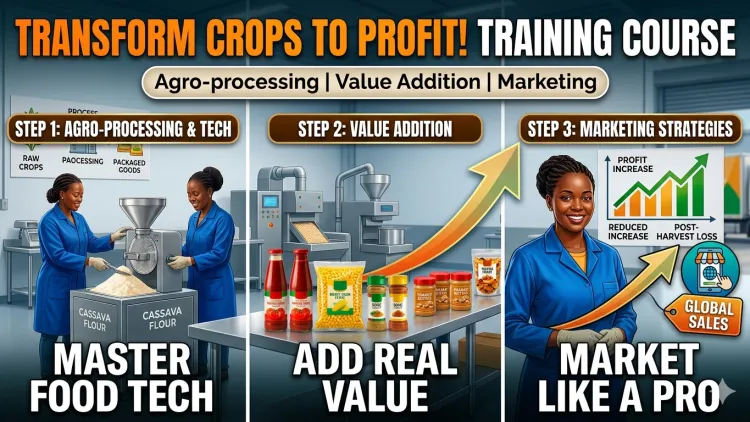
The agricultural sector holds immense potential for economic growth and job creation through strategic agro-processing and effective value addition. This comprehensive training course is meticulously designed to equip participants with the essential knowledge and practical skills in cutting-edge food processing technologies, innovative value-added product development, and impactful marketing strategies. Learn how to transform raw agricultural produce into higher-value products, extend shelf life, reduce post-harvest losses, and effectively reach target markets. Mastering agro-processing and value addition, encompassing advanced food processing technologies, creative value-added product development, and robust marketing strategies, is crucial for thriving in the modern agri-business landscape.
This intensive training course delves into the entire spectrum of agro-processing and value addition, providing participants with actionable insights from farm to market. We will explore a wide array of food processing technologies suitable for various agricultural commodities, guide you through the process of conceiving and developing profitable value-added products, and equip you with the marketing strategies necessary to successfully launch and scale your agri-business ventures. The curriculum emphasizes practical application through case studies and real-world examples, ensuring participants gain the confidence and expertise to capitalize on the burgeoning opportunities within the agro-processing sector.
Curriculum & Topics
15 Topics | 75 Sessions
-
 Workshop 1.1:
Defining agro-processing and its significance in economic development for your module.
-
Workshop 1.2:
Exploring the benefits of value addition for farmers, processors, and consumers.
-
Workshop 1.3:
Analyzing the current trends and opportunities in the agro-processing sector.
-
Workshop 1.4:
Analyzing the current trends and opportunities in the agro-processing sector.
-
Workshop 1.5:
Identifying key factors for success in agro-processing ventures.
-
Workshop 2.1:
Exploring various methods of food preservation (e.g., drying, canning, freezing) for your module.
-
Workshop 2.2:
Understanding the principles of thermal processing and pasteurization.
-
Workshop 2.3:
Learning about fermentation technologies and their applications in food processing.
-
Workshop 2.4:
Examining milling, grinding, and extraction techniques for different agricultural commodities.
-
Workshop 2.5:
Understanding the basics of food extrusion and its applications.
-
Workshop 3.1:
Delving into advanced drying technologies (e.g., freeze-drying, spray drying) for your module.
-
Workshop 3.2:
Understanding modified atmosphere packaging (MAP) and vacuum packaging.
-
Workshop 3.3:
Exploring irradiation and pulsed electric field processing.
-
Workshop 3.4:
Learning about membrane separation technologies in food processing.
-
Workshop 3.5:
Examining emerging technologies in food preservation and processing.
-
Workshop 4.1:
Understanding the principles of product innovation and design thinking in the food sector for your module.
-
Workshop 4.2:
Identifying market needs and consumer trends for value-added products.
-
Workshop 4.3:
Brainstorming and generating new product ideas based on agricultural resources.
-
Workshop 4.4:
Evaluating the feasibility and potential of new product concepts.
-
Workshop 4.5:
Understanding intellectual property considerations in product development.
-
Workshop 5.1:
Learning the principles of food formulation and recipe development for processed foods for your module.
-
Workshop 5.2:
Understanding the role of different ingredients and additives in food processing.
-
Workshop 5.3:
Mastering techniques for creating prototypes and conducting sensory evaluations.
-
Workshop 5.4:
Addressing nutritional aspects and health claims in product development.
-
Workshop 5.5:
Ensuring product stability and shelf-life during formulation.
-
Workshop 6.1:
Understanding food safety regulations and standards (e.g., HACCP, GMP) for your module.
-
Workshop 6.2:
Implementing quality control measures throughout the processing chain.
-
Workshop 6.3:
Learning about foodborne illnesses and their prevention.
-
Workshop 6.4:
Mastering hygiene and sanitation practices in food processing facilities.
-
Workshop 6.5:
Understanding traceability and recall procedures in the food industry.
-
Workshop 7.1:
Understanding the functions and types of food packaging materials for your module.
-
Workshop 7.2:
Designing effective and attractive packaging for value-added products.
-
Workshop 7.3:
Mastering labeling requirements and regulations for processed foods.
-
Workshop 7.4:
Communicating product information and nutritional value through labeling.
-
Workshop 7.5:
Exploring sustainable packaging options.
-
Workshop 8.1:
Understanding the importance of market research in the agri-food sector for your module.
-
Workshop 8.2:
Identifying target consumer segments for processed agricultural products.
-
Workshop 8.3:
Conducting market analysis to understand consumer preferences and trends.
-
Workshop 8.4:
Evaluating competitor products and market positioning.
-
Workshop 8.5:
Utilizing market research data for product development and marketing strategies.
-
Workshop 9.1:
Understanding the principles of the marketing mix (Product, Price, Place, Promotion) in the agri-food sector for your module.
-
Workshop 9.2:
Developing effective pricing strategies for value-added agricultural products.
-
Workshop 9.3:
Identifying appropriate distribution channels for reaching target markets.
-
Workshop 9.4:
Understanding the basics of personal selling and customer relationship management.
-
Workshop 9.5:
Developing a basic marketing plan for processed agricultural goods.
-
Workshop 10.1:
Building a strong brand identity and brand messaging for processed agricultural products for your module.
-
Workshop 10.2:
Utilizing digital marketing strategies (e.g., social media, online advertising) in the agri-food sector.
-
Workshop 10.3:
Understanding the role of content marketing and storytelling in agri-food branding.
-
Workshop 10.4:
Exploring public relations and media engagement for brand building.
-
Workshop 10.5:
Developing effective sales promotions and loyalty programs.
-
Workshop 11.1:
Understanding different distribution channels for reaching consumers and businesses (e.g., direct sales, retailers, wholesalers) for your module.
-
Workshop 11.2:
Managing the supply chain for processed agricultural products efficiently.
-
Workshop 11.3:
Addressing logistics and transportation considerations in the agri-food sector.
-
Workshop 11.4:
Understanding inventory management and warehousing for processed goods.
-
Workshop 11.5:
Exploring opportunities for e-commerce and online sales.
-
Workshop 12.1:
Understanding the key financial aspects of starting and running an agro-processing business for your module.
-
Workshop 12.2:
Developing a basic business plan and financial projections.
-
Workshop 12.3:
Calculating production costs and determining break-even points.
-
Workshop 12.4:
Understanding pricing strategies and profitability analysis.
-
Workshop 12.5:
Exploring sources of funding and investment for agro-processing ventures.
-
Workshop 13.1:
Understanding the principles of sustainable agro-processing practices for your module.
-
Workshop 13.2:
Implementing strategies for reducing waste and by-product utilization.
-
Workshop 13.3:
Exploring opportunities for circular economy approaches in food processing.
-
Workshop 13.4:
Understanding environmental regulations and compliance in the food industry.
-
Workshop 13.5:
Promoting sustainable sourcing of agricultural raw materials.
-
Workshop 14.1:
Identifying potential sources of funding for agro-processing businesses (e.g., grants, loans, venture capital) for your module.
-
Workshop 14.2:
Understanding the requirements and application processes for different funding opportunities.
-
Workshop 14.3:
Exploring government support programs and initiatives for agro-processing.
-
Workshop 14.4:
Networking with relevant organizations and stakeholders in the agri-food sector.
-
Workshop 14.5:
Developing a compelling business proposal for funding applications.
-
Workshop 15.1:
Analyzing real-world examples of successful agro-processing businesses and their strategies for your module.
-
Workshop 15.2:
Identifying key factors that contributed to their success in product development, marketing, and operations.
-
Workshop 15.3:
Learning from best practices and innovative approaches in the industry.
-
Workshop 15.4:
Discussing challenges faced by these ventures and how they were overcome.
-
Workshop 15.5:
Inspiring participants with tangible examples of agri-business success.