7 Topics
 5 Days
 35 Sessions
Programme Overview
Training Description
- Emergency Preparedness and Planning Officers
- Crisis Management Professionals
- Government Disaster Management Officials
- Humanitarian Information Management Specialists
- Climate Risk and Resilience Professionals
- Critical Infrastructure Risk Managers
- Emergency Operations Centre Personnel
- Policy and Strategic Planning Officials
- Technology and Innovation Professionals
- Professionals involved in risk monitoring, forecasting, early warning, early action, emergency preparedness, disaster response, climate resilience, and real-time risk intelligence.
Session Objectives
- Understand operational mechanisms for prediction, forecasting, monitoring, and response. Develop tools for early warning audits and identify current gaps. Design multi-hazard end-to-end EWS for disaster risk reduction. Develop strategies to institutionalize EWS into development planning. Design and implement people-centered community-based EWS. Evaluate and introduce public education and training programs. Apply emerging climate prediction technologies for risk management.
About the Course
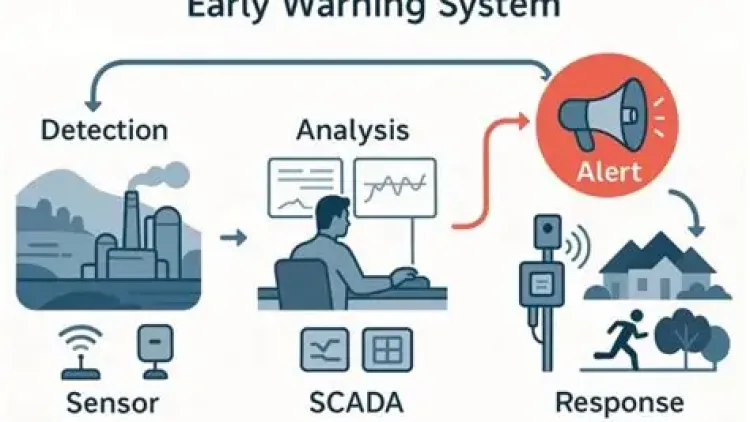
Strategic Early Warning Systems & Real-Time Risk Monitoring is an advanced training course designed to equip disaster risk professionals, emergency managers, policymakers, analysts, and resilience practitioners with the knowledge and practical skills required to identify emerging threats, monitor evolving risks in real time, strengthen early warning capabilities, and support timely early action.Key areas include real-time risk monitoring, GIS and remote sensing, sensor and observation networks, predictive analytics, geospatial intelligence, dashboards, automated alerts, situational awareness, risk communication, and decision-support systems. The course also addresses the challenges of data quality, uncertainty, interoperability, false alarms, and ensuring warnings reach vulnerable populations in an accessible and actionable form.
Through practical exercises, case studies, simulations, and early-warning system design activities, participants will develop the ability to monitor risk dynamically, interpret warning signals, establish effective triggers, coordinate early action, and strengthen preparedness before hazards escalate into disasters.
Curriculum & Topics
7 Topics | 35 Sessions
-
 Workshop 1.1:
Key elements of people-centered early warning systems
-
Workshop 1.2:
Hazard detection, forecasting, and risk interpretation
-
Workshop 1.3:
The link between early warning and disaster preparedness
-
Workshop 1.4:
Role of real-time data in proactive decision-making
-
Workshop 1.5:
Frameworks for integrating early warning in national systems
-
Workshop 2.1:
Identification and classification of hazards
-
Workshop 2.2:
Use of satellite imagery, sensors, and IoT technologies
-
Workshop 2.3:
Real-time surveillance and alerting platforms
-
Workshop 2.4:
Predictive modeling and scenario simulation
-
Workshop 2.5:
Data accuracy, thresholds, and false alarm management
-
Workshop 3.1:
Designing robust and scalable early warning networks
-
Workshop 3.2:
Hardware and software requirements for real-time operations
-
Workshop 3.3:
GIS-based platforms for spatial risk visualization
-
Workshop 3.4:
Integration with national meteorological and seismic systems
-
Workshop 3.5:
Data transmission, processing, and fail-safe mechanisms
-
Workshop 4.1:
Effective dissemination channels for risk information
-
Workshop 4.2:
Role of media, SMS, radio, and mobile applications
-
Workshop 4.3:
Message design for clarity, urgency, and accessibility
-
Workshop 4.4:
Ensuring inclusivity in reaching at-risk populations
-
Workshop 4.5:
Evaluating response behavior and message effectiveness
-
Workshop 5.1:
Roles of national and local authorities in early warning
-
Workshop 5.2:
Establishing protocols for data sharing and action triggering
-
Workshop 5.3:
Legal and regulatory frameworks supporting early warning
-
Workshop 5.4:
Coordination across meteorological, health, and civil defense sectors
-
Workshop 5.5:
Integration into disaster preparedness and emergency planning
-
Workshop 6.1:
Engaging local stakeholders in hazard monitoring
-
Workshop 6.2:
Training volunteers and local response units
-
Workshop 6.3:
Use of indigenous knowledge and local indicators
-
Workshop 6.4:
Designing low-tech and accessible warning tools
-
Workshop 6.5:
Building trust and ownership at the community level
-
Workshop 7.1:
Monitoring system performance and coverage
-
Workshop 7.2:
Conducting simulation exercises and functional drills
-
Workshop 7.3:
Incorporating AI and machine learning into alert systems
-
Workshop 7.4:
Continuous learning from false alarms and missed events
-
Workshop 7.5:
Updating systems in response to evolving risks