1 Topics
 5 Days
 1 Sessions
Programme Overview
Training Description
-
Risk & Compliance Leaders: Enterprise Risk Managers (CROs), Compliance Officers, Governance Managers, and Quality Assurance Leads needing a standardized framework (e.g., ISO 31000, ISO 9001) to structure enterprise operations.
-
Consultants & Advisors: Independent management consultants, risk advisors, and external auditors who guide organizations through framework implementation, gap analyses, or ISO audit readiness.
-
Internal & External Auditors: Audit directors, internal auditors, and lead auditors seeking accredited credentials (like ISO/IEC 17024) to validate their expertise in assessing governance and risk processes.
-
Operations & Project Managers: Business Unit Leaders, Operations Directors, and Project Managers responsible for managing operational risk, business continuity (ISO 22301), or information security (ISO 27001).
-
C-Suite & Executive Leadership: Board members and senior executives seeking structured, high-level frameworks for oversight and strategic decision-making.
Session Objectives
- 1. Evaluate how well candidates translate high-level ISO guidelines (such as ISO 31000, ISO 27001, or ISO 9001) into actionable policies, risk frameworks, and operational controls.
- 2. Test scenario analysis and decision-making skills rather than standard repetition
- 3. Ensure auditors understand how to collect objective evidence, perform gap analyses, draft non-conformity reports, and lead audit teams in accordance with ISO 19011
- 4. Ensure implementers master project management methodology to design, roll out, and maintain compliant organizational management systems from scratch.
- 5. Measure a professional’s capability to integrate international risk management principles into strategic corporate governance.
- 6. Align organizational risk tolerance with continuous monitoring, reporting, and crisis resilience frameworks.
About the Course
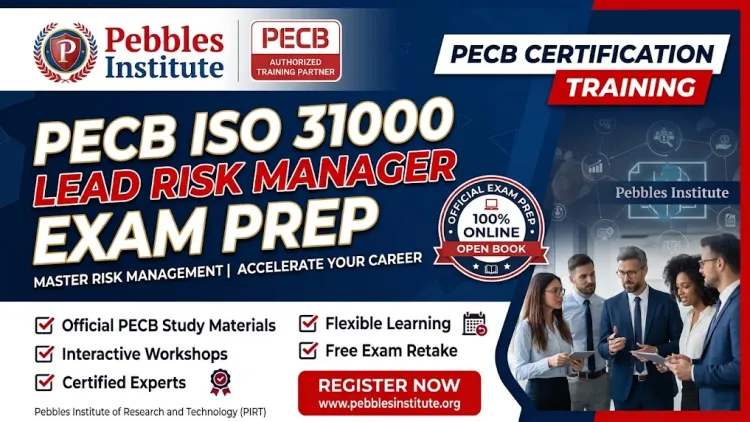
PECB (Professional Evaluation and Certification Board) is an ANSI/ISO/IEC 17024 accredited certification body that provides training, examination, and personnel certification across management system standards, including ISO 31000, ISO 27001, and ISO 9001.
Certification Levels & Structure
1. Foundation Level: Covers core concepts, principles, and definitions. Typically consists of 40 multiple-choice questions, lasts 1 hour, and is closed-book.
2. Manager / Risk Manager Level: Covers operational implementation, risk assessment, treatment, and monitoring. Typically consists of 60 multiple-choice questions, lasts 2 to 3 hours, and is open-book.
3. Lead Risk Manager / Lead Auditor Level: Focuses on designing, leading, and auditing organizational risk frameworks. Typically consists of 80 multiple-choice or scenario-based questions over 3 hours, and is open-book.
Key Exam Rules & Logistics
• Open-Book Policy: For Manager and Lead level exams, you are allowed to bring hard-copy materials, including official ISO standard printouts, participant handouts, course notes, and a hard-copy dictionary. Electronic devices or soft-copy reference files are not permitted.
• Passing Score: The pass mark across PECB exams is 70%. Results are delivered on a Pass/Fail basis via email within 6 to 8 weeks, along with a domain breakdown if retaking is needed.
• Delivery Method: Exams can be taken remotely online via PECB's proctored exam application or in-person through authorized PECB training partners.
• Retake Policy: Most PECB course registrations include one free retake within 12 months if you fail on the first attempt.
Curriculum & Topics
1 Topics | 1 Sessions
-
 Workshop 1.1:
N/A
Workshop 1.1:
N/A